From 1959 to 1975, Laos became the site for one of the least known, yet most devastating, conflicts of the 20th century. Though officially neutral, the country was drawn into the Vietnam War as the United States attempted to block communist expansion in Southeast Asia.
Through the Central Intelligence Agency, the United States (U.S.) led a covert military campaign, training and supplying a secret army made up largely of Hmong and other ethnic minority soldiers to fight the North Vietnamese Army and their ally, the Pathet Lao.
Between 1964 and 1973, the U.S. dropped more than two million tons of bombs on Laos, making it the most heavily bombed nation per capita in history. The war uprooted hundreds of thousands of civilians, destroyed villages and transformed the landscape.
Led by General Vang Pao, Hmong forces played a key role in rescuing downed American pilots, gathering intelligence and defending strategic areas in northern Laos.
When U.S. forces withdrew and a communist government took power in 1975, many Hmong who had sided with the Americans faced retaliation. Thousands fled across the Mekong River to refugee camps in Thailand, beginning a global Hmong diaspora that continues to influence families and communities today.
The Secret War remained classified for years, but its legacy continues to shape Hmong communities and postwar recovery efforts in Laos today.
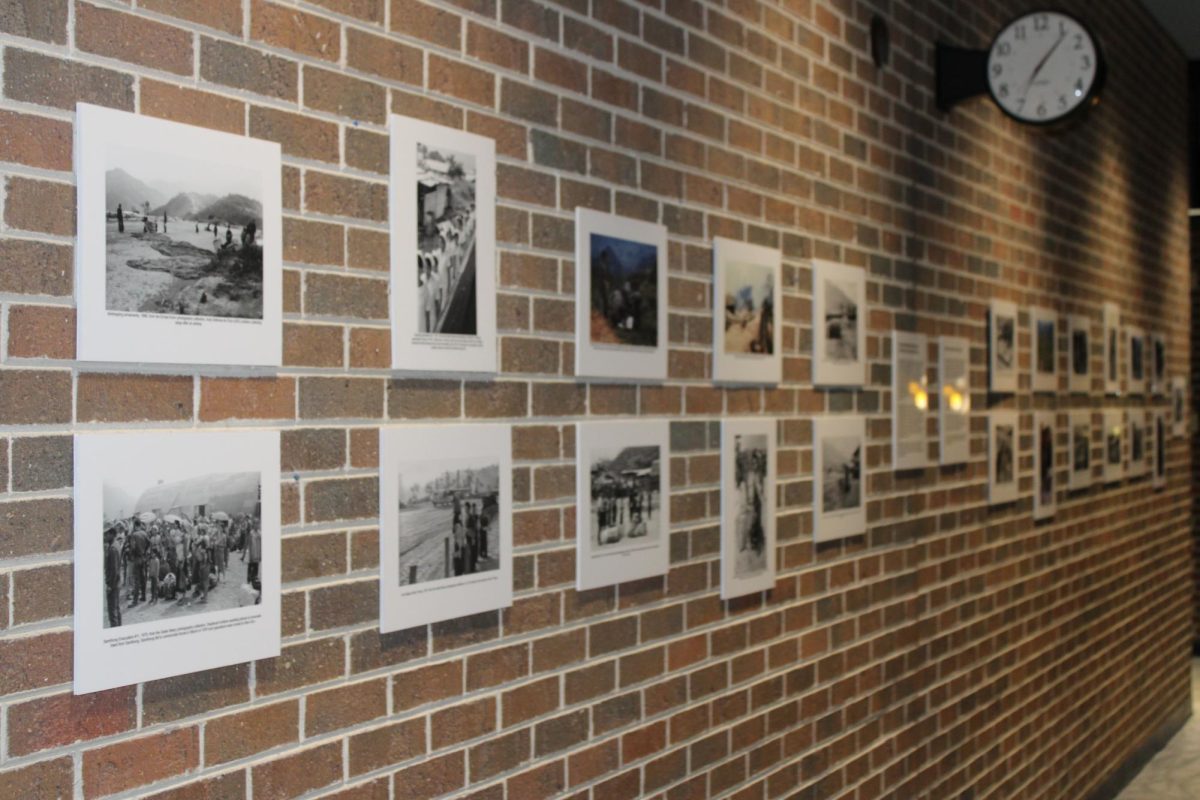
Located in UWL’s Center for the Arts, this exhibition commemorates the fiftieth anniversary of the end of the Secret War in Laos and honors the enduring strength of the Hmong and Laos people. Through the photographs of Ernest Kuhn and Galen Beery, this collection reflects on loss, resilience and remembrance in the aftermath of conflict.
Also created for this exhibition, is the Joss Paper Eagle. This honors the memory of all those who lost their lives during the Secret War in Laos. Soldiers, civilians, aid workers and the countless unnamed victims whose stories were never told.
In Hmong and other Southeast Asian spiritual traditions, Joss Paper carries deep ceremonial meaning. It is burned as an offering to ancestors and spirits, symbolizing the transfer of respect, remembrance and blessings into the afterlife. Through this ritual, the living communicate with the departed, bridging the seen and unseen worlds.
Shaped into the form of an eagle, this sculpture holds layered symbolism. For the University of Wisconsin-La Crosse, the eagle represents, strength, vision and perseverance. For this exhibition, however, it takes on new meaning. A spirit messenger rising above the devastation of war, carrying prayers for peace and remembrance across generations and borders.
Fifty years after the end of the Secret War, its echoes remain etched in the land and in memory. Across Laos, millions of unexploded bombs still lie buried beneath rice fields and villages, continuing to maim and kill civilians every year. Entire regions remain scarred, ecologically, economically and generationally by the war’s aftermath.
For the Hmong and Lao communities, the legacy is both personal and collective. Survivors carry stories of loss, resilience and survival. Stories that often went unacknowledged in American narratives of the Vietnam War. Many who fled in 1975 built new lives in refugee camps and later resettled across the world, from the mountains of Laos to the heartland of the United States.
This exhibit honors the people and places captured through the lenses of Ernest Kuhn and Galen Beery, who documented a war once kept out of sight. Their photographs return as both evidence and memory; fragments of a shared history to be acknowledged, preserved and reflected upon.
Ernest Kuhn worked as a field operations officer for the U.S. Agency for International Development (USAID) in Laos from the mid-1960s to the early 1970s. Based in Vientiane, the capital of Laos, and in the northeastern provinces of Sam Neua, Sam Thong and Xieng Khouang, he oversaw relief efforts in regions heavily impacted by the U.S. bombing campaign and the wider conflict known as the Secret War.
His photographs are now housed in the University of Wisconsin-Madison archives. These document refugee movements, village life and the effects of displacement on Hmong and Lao communities.
Galen Beery worked in Laos between 1970 and 1972 with International Voluntary Services and programs affiliated with USAID. Based primarily in northern Laos, he collaborated with humanitarian worker Edgar “Pop” Buell to provide aid to civilians and record the conditions faced by displaced families.
His photographs, preserved in the Galen Beery Legacy Collection at California State University, Fresno, depict daily life in refugee settlements, evacuation sites and the wartime landscape of rural Laos.
Together, their images create a rare visual record of civilian life during one of the most secretive chapters of the Indochina War, revealing the human side of a conflict largely hidden from public view.
This exhibition was conceived and curated by Yia Vue, whose research and creative work explore Hmong history, war memory and the enduring legacies of conflict in Southeast Asia. Developed in collaboration with volunteer faculty and students, the project brings together historical photography, cultural symbolism and contemporary reflection.
This exhibition is made possible through the support of UWL’s Departments of Art, Archaeology, Theatre & Dance and Race, Gender, and Sexuality (RGS), as well as the office of Access, Belonging, and Compliance (ABC), and the La Crosse Historical Society, among other partners dedicated to preserving and sharing these important stories.