Every room I walk into I am not greeted by a hello, but a glowing face staring into a screen. Our society’s obsession with our phones has pushed us out of the community and into our own heads. Spaces that were once built for conversation now sit in silence.
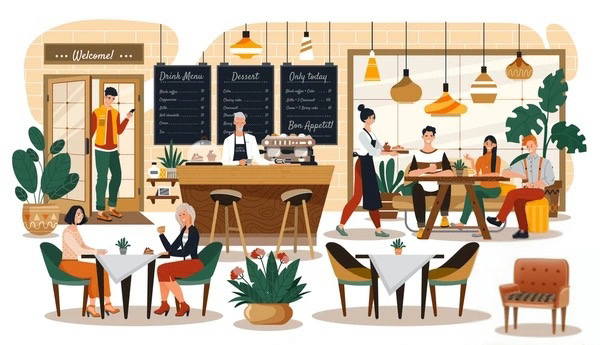
A place outside of work or home that is used for community or connection is known as a third space. A coffee shop or a pub, or public spaces like a park or a library are all great examples of third spaces.
I am here to argue that the problem isn’t a lack of third spaces, but a disconnect in how this generation expresses itself socially. Third spaces aren’t disappearing; they are becoming less socially active as social media makes physical interaction feel optional.
As a child, I often remember my mom telling me, “Get off that stupid phone and go outside.” These words ring truer and truer in today’s society. Sometimes I can feel myself fall into a negative cycle, and one of the clearest signs of this phase is a lack of social interaction and excessive phone usage. It is amazing how healing a walk and a conversation can be.
I spoke to a University of Wisconsin-La Crosse junior about this, and they had similar feelings to mine. They talked about their experiences with being alone and how social media can amplify those feelings. “I completely empathize with sitting in your home, staring at your phone, and going yeah…” This highlights how comfortable people are substituting digital interaction as a replacement for real connection.
Let’s take a step back and see what third spaces were originally supposed to look like. The concept comes from Ray Oldenburg and his 1989 book, The Great Good Place. He described third spaces as a place that fits these 7 characteristics:
- Open and inviting.
- Comfortable and informal.
- Convenient.
- Unpretentious.
- There are regulars.
- Conversation is the main activity.
- Laughter is frequent.
Doesn’t a place full of connection and laughter sound like such a great place to spend your time? But why when we walk into third spaces, like a coffee shop, is everyone buried in their screens and ignoring the stranger sitting 2 feet to their left? The coffee shop has been hijacked as a social space and turned into a workplace. So, the problem isn’t the space; it is how we use it.
I spoke to Wendy Koehnen and Maddie Schiltz, two UWL education majors. I asked them about what makes a space somewhere they want to spend their time. Maddie talked about her experience at the Palm + Pine yoga studio located here in La Crosse. “They [Palm + Pine] have worked so hard to cultivate a community there, and inclusiveness for anyone that wants to practice yoga,” she said.
Maddie emphasized how important it was to feel safe and comfortable in a space.
A fully present art form like yoga demands the practitioner to be completely devoted to the moment, not distracting themselves from it. This ideology is what we are missing in our daily lives.
When Wendy spoke about her experiences with third spaces, she talked about how a third space to her could be somewhere as simple as sitting in her car with her friends. “It’s not about the place it’s about the people.” This simple phrase sums up everything; it’s all about the connection.
One of the most important aspects of a third space is a culture of being present. It’s so easy whenever we feel awkward to pull out our phones and distract ourselves. This lifestyle of constant digital distraction leaves us more disconnected than ever. People are actively choosing to avoid social interaction when the opportunity to be engaged with others is right in front of them.
In my EDS 309 (Teaching Global Perspectives Across the Curriculum) class, taught by Daniel Walsh, Dr. Walsh has recently instituted a strict no-devices policy in his class. He enforces this rule as soon as you walk through the door. While this rule seemed annoying at first, as the weeks went on, I saw how the class dynamic started to shift. We were no longer sitting silently in our chairs staring at a screen; instead, we were conversing and building connections with our fellow students.
Third spaces still exist; they haven’t gone anywhere, but they have become a place where we coexist instead of connect. This loss of connection is making it harder for people to perform basic social skills. A conversation is starting to feel like a chore, not an opportunity. We haven’t lost third spaces, we have lost ourselves.
So I challenge you the reader, next time you sit down in public, don’t pull out your phone, take a moment and talk to a stranger. You might find connection was never as far away as it felt.