This article was written with support by Adam Stivers and Menard Family Initiative.
You have probably noticed that the economy is doing great, and that maybe you are not. As the findings show, this is a delusion or a failure of perception. It intricately describes the American economy. The gap between “the U.S. economy” and “you” is a story of our material and moral wealth. “We” is doing two things at once, and which one applies to you depends on a single fact: whether your income comes from what you own or from what you do.
If you own stocks, property, or a business, you probably had a spectacular year. Corporate profits – small and big businesses – were up $74.4 billion in Q1 CY2026. The stock market is up more than 25% year over year on the strength of the AI buildout. If you work for wages, prices grew 4.2%, while your pay grew 3.82%. Formally speaking, you got poorer while getting a raise. Such an economy is infamously referred to as the K-shaped economy, where different groups recover or grow along divergent trajectories – one arm of the K goes up, the other goes down, rather than moving together.
The Bureau of Economic Analysis reported that GDP grew at a 2.1% annualized rate in Q1 CY2026 – a desirable headline for worldly governments. When you dig deeper, the composition reveals a different reality. The growth came from investments, exports and government spending, while consumer spending was revised down. In simple words, the economy is expanding, but the people in it are not the reason.
Rent, the largest and stickiest component of the price index, remains about 41% above pre-pandemic levels. Energy costs spiked after the war with Iran, which pushed gasoline to roughly $4.79 a gallon. And the cushion is gone as well: the personal savings rate fell to 2.6% of after-tax income in April, an extreme low. Household spending is now increasingly financed by drawing down savings and reaching for credit. In simple words, the consumer half of the economy is running on fumes and borrowed money, which is precisely why the aggregate, the U.S. economy, can keep rising while the household sinks.
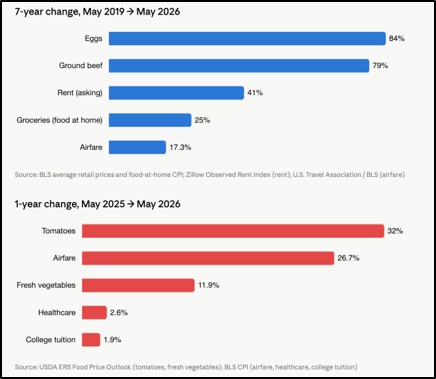
The charts refuse the easy story. Healthcare (+2.6%) and college tuition (+1.9%) have been remarkably calm. What has exploded is precisely the stuff you cannot opt out of: shelter. And the food on the table. In theory, you can defer a degree. But you cannot defer dinner.
While the economic position is decisive for the progress of a nation, I cannot look away from what is happening alongside it: a moral, cultural and racial regression. The aggregate numbers are too coarse to catch. And here the “we” inverts. Economically, we have quietly split into two. Split into a ‘K-shape’: owners on the upstroke, workers on the down. But the cost of that split, the fear and the scapegoating and the search for someone lower to stand on, lands on everyone. In this other half of the story, there is only one “we.” WE ALL. New York, in the first half of 2026, recorded the fewest murders and shootings in its history. In the same six months, N.Y.C. experienced a rise in hate crimes of 7.7%, and in May alone, they jumped 74.4%. The city grew dramatically safer and measurably more hateful at the same time.
The legislative record shows a similar divergence. The American Civil Liberties Union (ACLU) tracked 575 anti-LGBTQ+ bills in 2025; 54 became law, and Iowa became the first state to rescind existing nondiscrimination protections for transgender people, rights that had been in the state code since 2007. Morally, when we look away from lives unlike our own, the loss is not only theirs. A society that narrows the range of visible lives makes itself smaller. The measurable version of this is well documented: one analysis of more than nine million scientific papers found that ethnically diverse authorship drew up to 48% more academic citations: a difference, quite literally, that produces ideas that sameness cannot reach.
But the deeper loss never shows up in a data set. To look away from a life unlike yours is to lose the chance to witness another way of being human. Another answer to the question of how one might live. A person who has seen only lives shaped like their own has not been kept safe. They have been kept small. The richest society is not the one that tolerates its differences but the one that lets them teach it, because a country with many ways of living is one where every person has more than one way to be. From an immigrant’s lens, that’s what makes U.S… US.
Americans genuinely, fiercely disagree about whether that is progress or regression, and I will not adjudicate it here. Statistics describe populations, not people. No one lives in the average. When the aggregate says the country is thriving and your individual economic condition says otherwise, the aggregate is not lying to you. It is simply not talking about you. So: richer or poorer? Both. And anyone who tells you otherwise is quietly deciding which of us counts.