
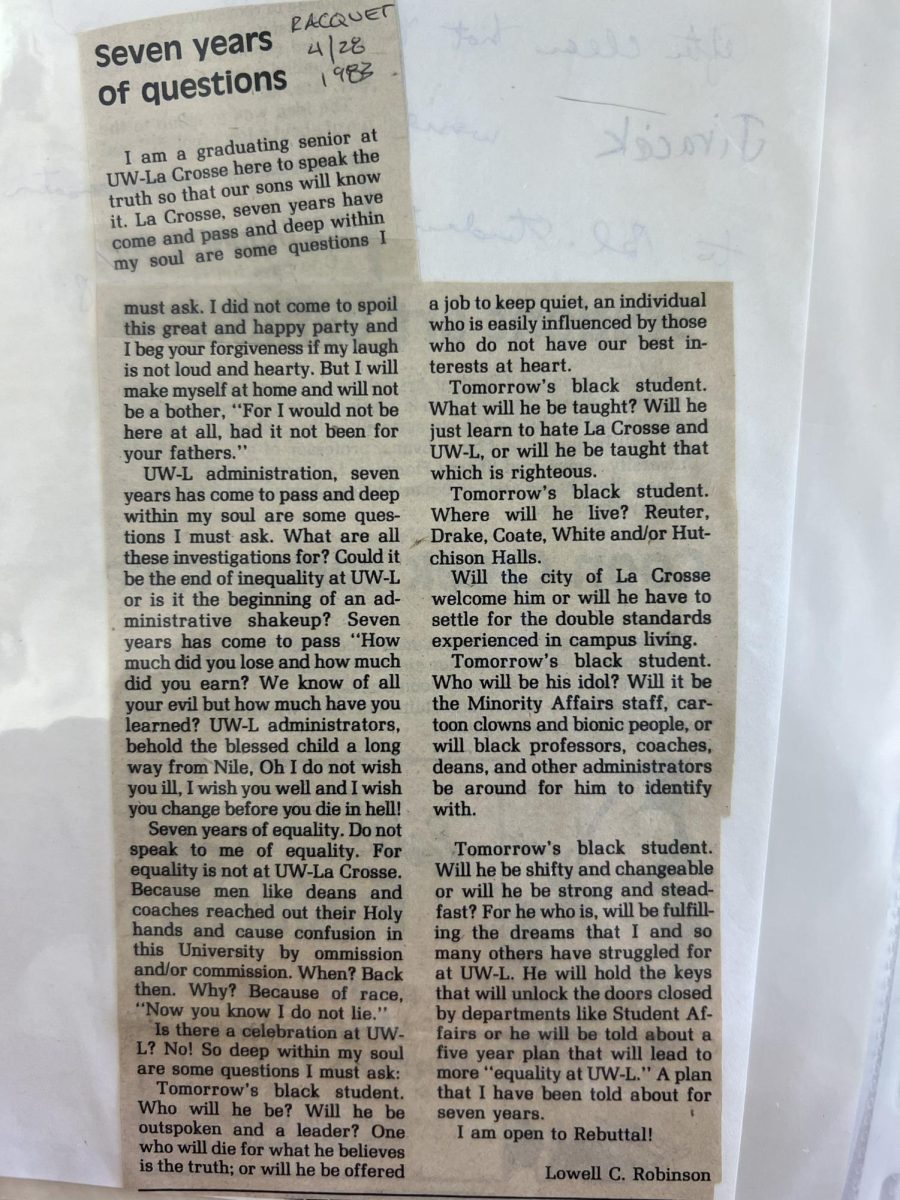
In 1983, Lowell C. Robinson wrote a letter to The Racquet Press titled “Seven years of questions.” He was a Black graduating senior who looked at his time at UW-La Crosse and asked what kind of world “tomorrow’s black student” would inherit. He wondered if that student would be a leader or someone paid to stay quiet, whether he would be welcomed in the city, and whether he would be taught to hate this place or taught “that which is righteous.”
My experience at UW-La Crosse has been mixed. On one hand, being one of the few Black people in La Crosse is an extreme challenge. Across campus and in the city, I have seen and experienced everything from subtle slights to more serious incidents, but one thing stayed consistent. It was hard not to be noticed. The stares were real, and so was the feeling of being under a microscope.
On the other hand, there were people who refused to let race be a wall and instead became a refuge. So I too do not write this out of contempt. I know many would like me to scream and shout with joy, but I cannot, for there are some things I too must say. I would be remiss not to acknowledge that the same structures that caused me grief also created space for my biggest opportunities. There are faculty, staff and students who work every day to make this place better and who invite students like me into the conversation instead of speaking for us, however most do not share that sentiment.
The university’s relationship with race is not simple or linear. I see progress and good intentions, and I also see many of the same problems that were present in the 1980s taking new forms. Black students are still watched closely. People who wish us harm, or simply wish us away, have learned to blend in with those who mean no harm at all. Inclusion is often facilitated in public, while isolation continues quietly in practice.
The grief is not just particular to people of color but also women. Too often, people of color and women on this campus still go through most days unseen in the ways that matter, interrupted in classrooms, spoken over in meetings, and told to “study your history.” The harm is not always loud. Sometimes it is the steady message that some voices are optional.
I have also seen and understand how difficult it can be to bring hard history into the open, but it does belong to everyone and it is not for the privileged few to determine who is spoken about and what no one wants to hear about. Yes, legally and on paper, we have made great strides toward equality. In spirit, however, we still have not had the deep, mutual meeting of minds and hearts that real change requires.
So I want to adjust Robinson’s question. It should not only be, “Who will tomorrow’s Black student be?” It should also be, “Who will tomorrow’s UWL be?”
What kind of community are we building for the students who come next? Who will be in the room when decisions are made? Are Black students, other students of color and women actually included, or still mostly expected to adapt to systems that were not built with them in mind? Is this a place that builds up everyone who comes through its doors, or only some?
To get there, all of us have work to do. There is nothing wrong with being scared or needing to step back for a moment. There is nothing wrong with saying honestly, “I do not like this,” and asking for better. What matters is that we keep coming back to the table, keep challenging our own habits, and keep refusing to let anyone’s humanity be treated as optional.
My hope is that we find enough clarity to grow with change instead of fighting it, and that we outgrow the fears we inherited. We may be more together than we are alone. Tomorrow’s UW-La Crosse will show whether we chose to be.
Sincerely,
Adrian Miguel Moreno
History and Philosophy, Class of 2025






SS • Dec 2, 2025 at 7:32 pm
When will it be enough? Faculty come out publicly. Students come out publicly. Nothing ever gets acknowledged, and no action is ever taken. UWL exhausting.