

Dr. Miller is an assistant professor of media studies at the University of Wisconsin-La Crosse, who started at the university in the fall of 2021. His research and specialty areas include television, broadcast history, media policy, feminist and queer media studies, syndication and broadcast journalism.
Dr. Miller earned a Ph.D. in media and cultural studies from the University of Wisconsin-Madison. Prior to earning his Ph.D., he completed a Master of Arts in radio, television and film at the University of Texas Austin.
He holds two undergraduate degrees from the University of Kansas: A Bachelor of Science from the William Allen White School of Journalism and Mass Communication as well as a Bachelor of Arts in Spanish.
In this coming July, he will officially be a tenured professor of Media Studies in the Department of Communication Studies.
Dr. Miller recently put out an anthology on “The Golden Girls” with his co-editor Alfred L. Martin Jr. who is a professor at the University of Miami.
“It was a really exciting experience, I have to say,” said Dr. Miller.
In September 2025, the weekend before the 40th anniversary of “The Golden Girls”, Dr. Miller released the scholarly anthology dedicated to the iconic sitcom.
“12 chapters, all of them written by different academics across the country. They are in-depth discussions of various aspects of the show,” said Dr. Miller.
The book explores a range of topics tied to the cultural and historical context of the series.
“For instance, one chapter written by one of our contributors is all about diet culture in the 80s, and how women were navigating that,” Dr. Miller said.
In addition to academic essays, the book includes original interviews with individuals involved in the show’s production.
“In between each of the chapters, we did interviews with the creators and producers of the show, to get an idea of some of those behind the scenes stories,” said Dr. Miller.
He also described the anthology as a comprehensive resource for classroom use.
“This is essentially a textbook. If students use it in a class, they would have both secondary sources from the academics who wrote books, but also primary source material from the interviews,” said Dr. Miller.
To celebrate the publication, a book event took place Jan. 29 at Pearl Street Books. The event featured a themed murder mystery as an homage to an episode of the show. Miller performed a reading before theatrically “dying,” prompting attendees to solve clues to determine the culprit.
Beyond his publication work, Miller is the director of the Communication and Media Lab, otherwise known to students and faculty as the CaML.
During his second year at UWL, faculty members approached him about leading the development of a new media lab in the library, after the original faculty lead, Wendi Bellar, accepted a position elsewhere.
“She had put together the foundation and the grant for it, but I came in and actualized the CaML. Now I’m the director, and will be until 2029 at least,” said Dr. Miller.
Drawing on his previous experience working in media labs in Georgia and at Madison, Miller accepted the role and formally launched the CaML.
Dr. Miller also took one of Bellar’s courses, which was called Multimedia Production, and renamed it Digital Media Production, giving it a primary focus of videography.
“It’s the marquee course of the CaML. In that class students learn the fundamentals of digital media production, and the capstone every year is a horror short,” said Dr. Miller.
The course redesign reflects Miller’s broader effort to modernize the curriculum while preserving the department’s production-based roots. By emphasizing hands-on videography, storytelling and editing, he said he hopes to equip students with practical skills that mirror professional expectations. At the same time, the shift connects to a longer history of broadcast training on campus.
“We used to have an on-campus TV station in the WING Technology Center. There’s a big former television studio,” said Miller.
That studio space, once active with student productions and live broadcasts, reflects a period when students regularly trained in a professional-style environment before entering the workforce. According to Miller, the program had a reputation for preparing graduates who could step directly into newsroom roles.
“Students would be churned out from our program and go immediately to work in local news. And I thought that all of these stations must miss the former iteration of our department because we used to churn out graduates who were trained to do what they did,” said Miller.
Dr. Miller then proposed a model that would allow students to produce professional-level content while still enrolled in classes. The collaboration was structured as an independent study, giving students the chance to create work with the possibility of it being aired.
“I reached out to all of the local affiliates and I worked very closely with a person named Joe Radske at WEAU. I said, here’s what I want to do, I want to have a little independent study class where students in that class create packages and voiceover content for the news. And then we send it to you and you use it or you don’t use it. And often they did use it. Which meant that stuff UWL students were creating and producing in the CaML was being broadcast to all 262,000 households in our area,” said Dr. Miller.
The opportunity gave students experience beyond the classroom, allowing them to see their work reach a regional audience and meet professional broadcast standards. It also strengthened relationships between the university and local newsrooms, reinforcing the role of campus media programs as a pipeline for emerging journalists and content creators.
“The last time I did this was in the fall, and next fall, we’re going to do something a little bit different. Now I’m working with WKBT, which is in town, and they’re creating something called an ‘Eagle Beat Intern’ and it’s essentially going to be for all social media affiliated with the station,” said Dr. Miller.
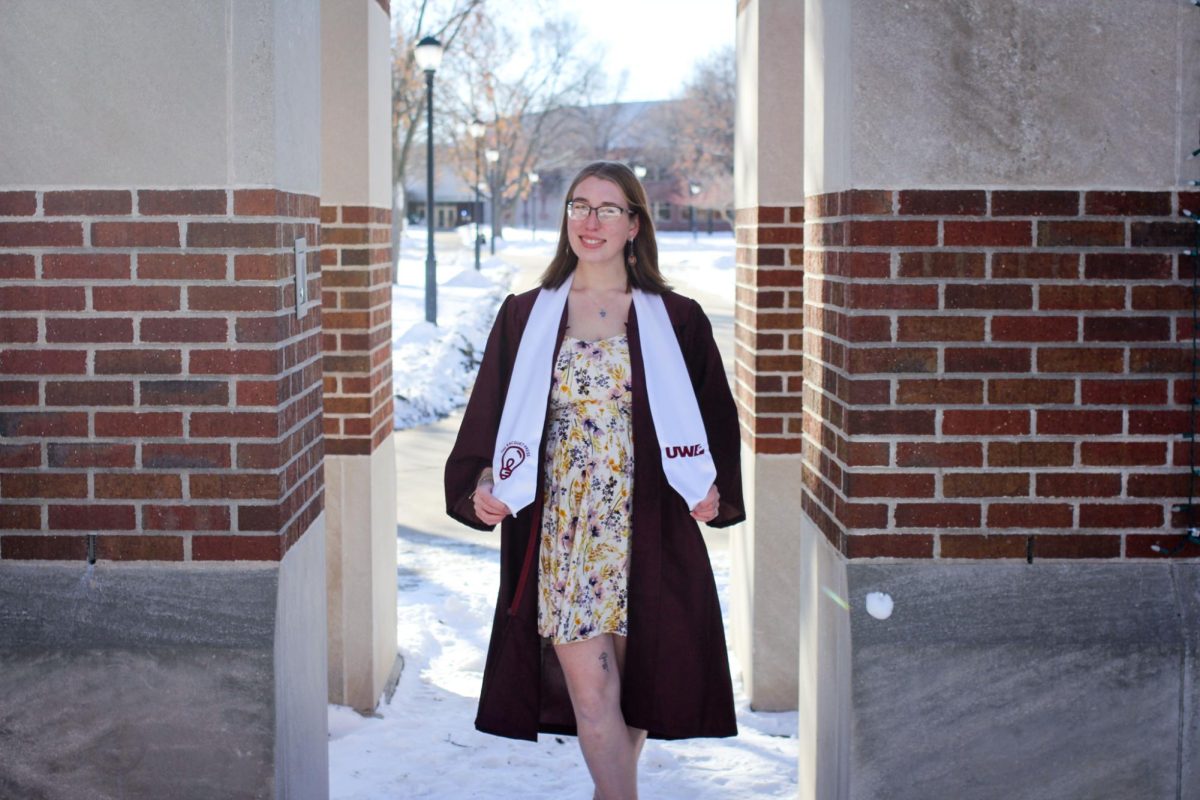
The initiative builds on a shared vision between Miller and former Racquet Journalist, Ellie Davis, who incentivized Miller into shaping the idea of deeper collaboration with local news organizations.
Miller prioritizes student ambition when designing opportunities, often tailoring projects to align with individual career goals.
“She knew what she wanted to do, and whenever I have a student who’s so passionate about something, I’m gonna figure out a way to help them do it,” said Dr. Miller.
Miller mentioned that Davis’s commitment has defined his time at UWL. During his first semester teaching at UWL, she was in one of his classes. Over the course of Davis’s academic career, he mentored her as she refined her interests and prepared for a career in media, ultimately graduating in fall 2025.
For Miller, those student successes remain the most meaningful part of his work.
“I constantly tell all the faculty here, it feels like you saved my life, because just the satisfaction I get from things like when I worked with Ellie, nothing compares to it,” said Dr. Miller.
As he prepares to receive tenure this summer, Miller continues to balance scholarship and practice using media studies to examine television history while also creating hands-on opportunities that prepare the next generation of storytellers for careers in a rapidly evolving industry.




Peggy Miller • Feb 20, 2026 at 3:30 pm
We love that you are always willing to do whatever you can for your students and that you truly love what you do! We are so very very proud of you Taylor!
Love
Dad and Mom