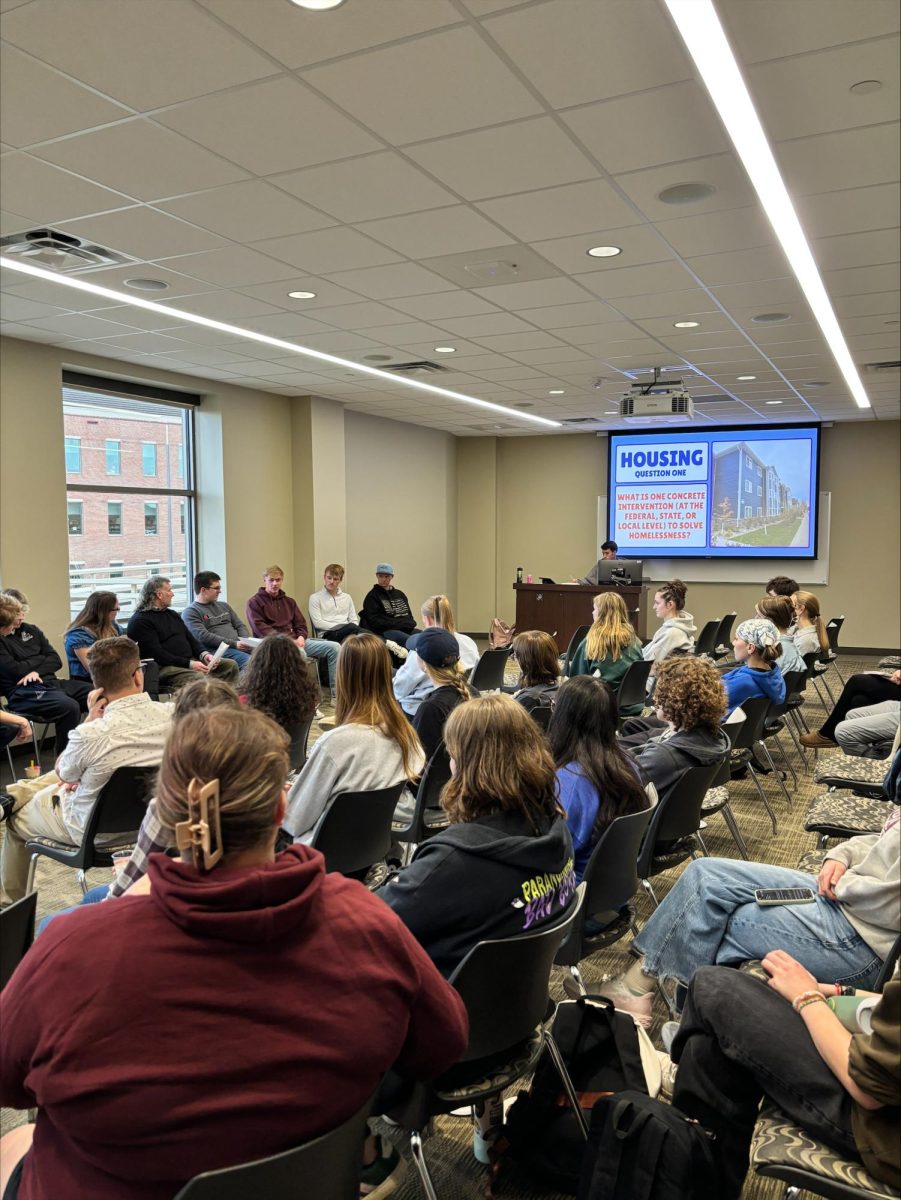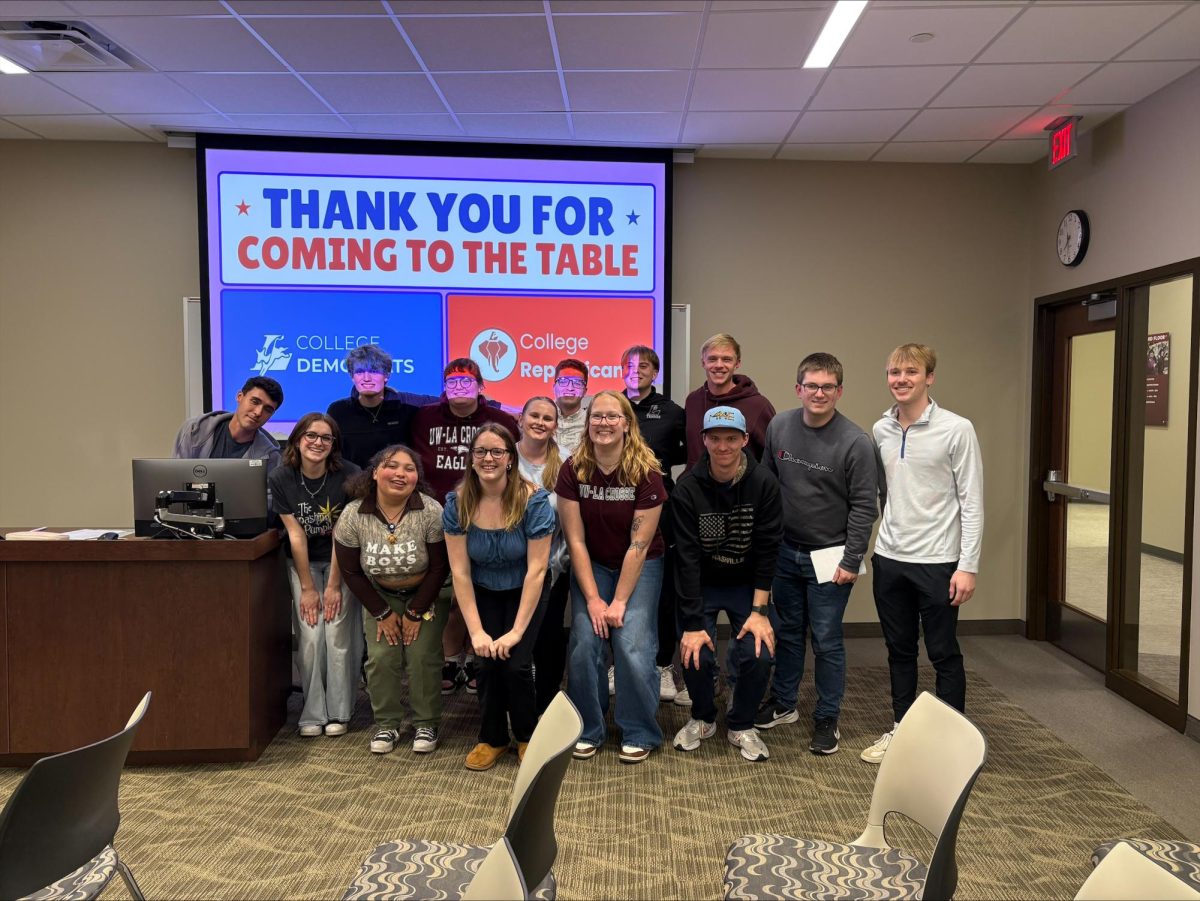
On Tuesday, March 31, the UWL College Democrats and College Republicans hosted a roundtable discussion aimed at encouraging honest engagement, critical thinking and mutual understanding.
Co-chairs of the UWL College Democrats, Cisco Garcia and Hannah Bauknecht, and Chairman of the College Republicans, Ryan Kitzan, introduced the event. Ahead of the event, the two clubs worked together to create a list of questions for their designated members to discuss with one another.
Both the UWL College Democrats and College Republicans delegated members from their club to speak to different areas—including housing, gun control, foreign policy, healthcare and immigration. The roundtable was structured so that each topic featured four representatives from each club who discussed their viewpoints while responding to concepts from the other side. To ensure a nonpartisan perspective and keep the conversation on topic, Professor Jermey Arney monitored the discussion.
As the discussion moved through each topic, gun ownership quickly became one of the more debated issues of the evening. Students from both organizations shared differing perspectives on firearm regulations and their interpretation of the Second Amendment.
Ryan Kitzan emphasized that gun ownership is protected under the U.S. Constitution. “Gun ownership is a constitutional right,” Kitzan said. “We do not require background checks for you to speak freely.”
Colin Olson responded by drawing comparisons to free speech protections, noting that even constitutional rights such as free speech still have limits when they pose harm to others. He argued that gun ownership carries similar responsibilities. “That [gun ownership] is a power that needs to be regulated,” he said.
Cael Schoemann, Vice Chairman of the College Republicans, offered a perspective that differed from some of his peers. “A background check and mental health check is extremely important,” Schoemann said.
The conversation expanded to consider the broader role of firearms in the United States. Beck Sissel argued that the Second Amendment has contributed to the idea that guns must be kept without regulations in order to ensure citizens can protect themselves against the government.
“Now if you genuinely believe there is any way that a regular group of American citizens could somehow stop the government from doing whatever they want, that’s ridiculous,” Sissel said. “I think the Second Amendment has installed this culture in us that guns are necessary.”
Although participants each expressed different views on gun policy, the discussion repeatedly returned to whether regulations and safeguards should be required prior to obtaining a firearm.
Another topic that sparked engagement between participants was foreign policy. With recent U.S. involvement overseas, particularly in the war with Iran, many students shared their perspective on foreign policy.
Kitzan stressed that the average American has been disproportionately affected by foreign conflict. When asked if the Americans have benefited from the recent wars over the past two decades Kitzan responded, “If you work for Rathion or something, I’m sure you made a lot of money, I’m sure you’re very happy about that.” He continued, “But if we’re talking about the average American taxpayer, average American voter, probably not.”
Another member of the College Republicans, Trevor Doescher added, “They’re not sending people older than us to die, who’ve lived their lives. They’d rather send the people they don’t care about,” referring to college-aged Americans. “We’ve ruined these countries completely.”
While gun ownership and foreign policy sparked a lively discussion, other topics—such as housing, health care and immigration—saw students finding common ground despite their differing political affiliations.
Nearly everyone agreed healthcare in America is overly expensive and dominated by for profit businessmen. Doescher said, “We used to be a country that broke up monopolies, and now we have monopolies that control every little aspect of our life.” Members from both clubs agreed.
When discussing immigration, participants unanimously agreed in support of birthright citizenship. The conversation around immigration eventually shifted to the recent influx of ICE in communities. Matylda Szul, a member of the UWL College Democrats, said, “A just deportation process ends up being: we shouldn’t separate families, everyone gets a fair trial, and equal treatment no matter where you came from.” Once again, the room nearly all agreed.
The discussion ended with participants recognizing the progress made and exchanging handshakes. The roundtable discussion was a simulation of what American politics could be: respect, listening and understanding.