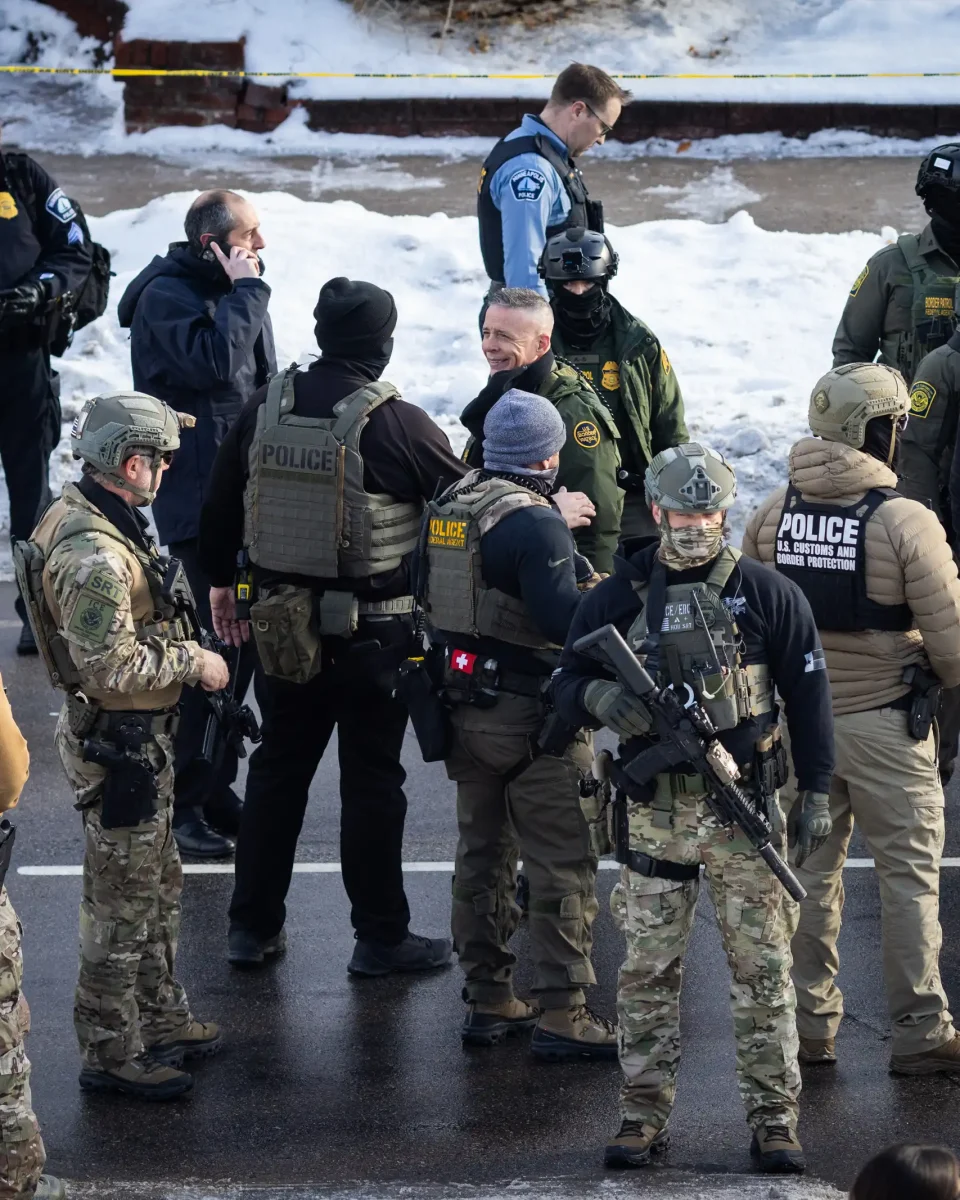
Since Donald Trump returned to office in January 2025, his administration has significantly expanded U.S. Immigration and Customs Enforcement (ICE). More than $12 billion in funding has been put into the agency to support the administration’s mass deportation initiative, which was one of the central promises of Trump’s election campaign.
ICE was originally created through the United States Department of Homeland Security as part of the Homeland Security Act of 2002, following the terrorist attacks of Sept. 11, 2001.
At its inception, the agency’s mission centered around public safety and national security. ICE has since transformed into something much larger, with immigration enforcement at its core.
Federal officials say ICE has hired more than 12,000 new agents within the past year in order to meet the demands of increased operations across the country. Many argue that this rapid expansion has come at the expense of adequate training.
According to internal documents obtained by CBS News, ICE’s officer training program was shortened from 72 days to just 42 days between July 2025 and February 2026. In addition, several courses related to the use of force were reportedly removed from the curriculum.

Concerns about inadequate training were brought to Congress by former ICE agent Ryan Schwank, who resigned on Feb. 13, 2026. In testimony on Feb. 23, Schwank warned lawmakers that the agency’s accelerated hiring efforts were putting officers on the streets without the training necessary to properly enforce immigration law. He also alleged ICE officials are lying about the amount of training new recruits receive.
“I am duty bound to tell you the ICE Basic Immigration Enforcement Training Program is now deficient, defective, and broken,” said Schwank.
ICE’s authority differs from that of the average police department in that its agents are able to stop, detain and arrest any individual they suspect of being in the U.S. illegally.
In certain situations, ICE can also detain U.S. citizens; for example, if an individual interferes with an arrest or assaults an officer.
Despite these limited circumstances, reports show that over 170 unwarranted U.S. citizens were detained and held against their will during the first nine months of Trump’s presidency. Just a few of the thousands of other arrests carried out since Trump’s return to the White House.
Not only has ICE unlawfully arrested U.S. citizens but their lack of training has resulted in 26 fatal shootings, more than 28 injuries and 44 deaths in custody according to data compiled from public reports.

Under the U.S. Constitution, law enforcement can only use deadly force if the person poses a serious danger to them or other people, or the person has committed a violent crime. Recent incidents involving ICE raise serious questions about whether those standards are being followed.
Two of the most notable deaths that drew public attention were the Jan. 24 shooting of Minnesota Nurse Alex Pretti, and the Jan. 7 shooting of 37 year old Renee Good.
Since Trump’s return to the white house, more than 605,000 immigrants have been deported. Officials also estimate that roughly 1.9 million additional people have voluntarily left the country, bringing the total number to more than 2.5 million.
For immigrants who encounter ICE agents, the outcomes can vary widely. Some individuals are briefly detained and released after questioning. Others are transferred to larger detention facilities.
Immigration attorneys told the BBC that locating detained individuals can be extremely difficult. In some cases, families and lawyers may wait days before learning where a person has been taken.

The surge in deportations has also had an extreme ripple effect on immigrant families. The removal of men, women and children, often results in family separation.
The federal government does not have comprehensive data on how often children enter state custody after a parent is detained or deported. However, available reports confirm at least 32 cases in the past year in which children of detained immigrants entered the foster care system.
Protests fighting back against ICE operations have taken place across the United States and have expanded globally. In several major cities, tens of thousands of people have taken to the streets, reflecting the outrage surrounding ICE.
What UWL students have to say:
“I’m concerned about the racial profiling, excessive force and human rights violations. I’m even more concerned about the Trump administration’s lack of accountability. I think ICE needs significant reform. It’s concerning to see ICE agents escalate situations. I think about Alex Pretti being shot 10 times, and can’t think of any scenario in which it’s justifiable to continue shooting a motionless body. Seems like a sick and twisted display of power. I’m shocked at the lack of checks and balances in our government right now. I think this current congress is one of the least productive ever. I’m concerned the 8-week training period for ICE agents isn’t long enough and doesn’t properly prepare them. Although I’m a liberal, I can agree with republicans that I don’t want violent illegal immigrants in this country, but I don’t want that to be at the cost of law-abiding immigrants who came to the U.S. for a better life and are paying into taxes they’ll never reap the benefits from,” said a UWL senior.
“I missed a week of classes because I found out ICE was in La Crosse. I was like, ‘I would rather miss a week of class than get deported,’” said a UWL senior.
“ICE is an embarrassment to our country. My heart goes out to all of the victims detained by them under Trump’s reign of presidency. I pray you are all reunited with your families and friends as soon as possible,” said a UWL junior.
“I’ve got a brother-in-law who was born in Mexico, so I would not like to see him gone. I feel like there’s so many different groups that they [ICE] are attacking that it makes me question like, ‘who’s next?’ Because it’s gonna keep evolving. First it was the Mexican immigrants, now it’s the Somali immigrants, now it’s white Americans. I also think it’s just scary that we’re taking them to the Olympics, that’s literally like secret police,” said a UWL sophomore.
“Honestly, ICE is absolutely terrifying. I’ve had friends who have been in worse positions than me. In my hometown my sister can’t even enjoy hanging out with her friends, because they’re afraid of being deported. So that has made it even more amplified for me. Also, people from my community are already getting separated. It is terrifying. I myself am dealing with it too, cause I am not from here. I am a U.S. citizen but I don’t look like one, I don’t look white. So my reality is so distorted. I am afraid to go to classes, so sometimes I just ask to do classes online instead because I am afraid of being quite literally kidnapped. I don’t think there’s enough being said about it,” said a UWL senior.
“Fuck ICE,” said a UWL sophomore.
“Honestly it’s scary to think something like this is happening so close to all of us. No one deserves such treatment. My thoughts and prayers go out to those being impacted by these terrible events,” said a UWL senior.
“My opinion on it is that no one is illegal on stolen land, and if we all just focused on peace that we could be doing a lot bigger and greater things to bring our country together,” said a UWL freshman.
“I think there’s a very specific reason that the current administration is giving all these resources to ICE. It’s kind of hard to argue against capturing undocumented immigrants because it is a crime, like if you argue against it, people could just say, ‘Oh, you just like crime then.’ But I think what they are trying to do is by giving all of these resources to ICE and not a lot of oversight, they are just kind of trying to push the boundaries of what the American public will accept. There’s a lot of violence going on, there’s a lot of outrage going on, but at the end of the day nothing has really happened. No one is really stopping the current administration from using ICE in this way. I think it’s just going to be a stepping stone to something bigger with more military action, and with more violence towards immigrants, American citizens and a lot of minority groups,” said a UWL senior.
There are several locations in La Crosse that provide resources for handling interactions with ICE, including Pearl Street Books, The Root Note and Larson’s General. Additionally, you can submit reports about ICE in the surrounding area to Ice Out Coulee via iceout.org, and you can also contact Voces de la Frontera or visit their website for more information.